How does London’s food scene compare to other UK cities?
London has the UK’s most diverse food scene overall, but it no longer holds an unchallenged lead. Cities like Manchester, Birmingham, Edinburgh, and Bristol have built genuinely exciting, varied dining cultures of their own, and in some areas, including Indian street food, the regional cities more than hold their own. This article works through the questions food lovers are actually asking about where to eat well across the UK right now.
Which UK city has the most diverse food scene?
London remains the most diverse food city in the UK by sheer volume and variety, with restaurants representing virtually every cuisine on earth across its boroughs. But diversity is not just a numbers game. Manchester, Birmingham, and Bristol have developed food cultures that punch well above their weight, offering genuine depth in specific cuisines rather than a scattershot spread of options.
Birmingham, for instance, has long been recognised as one of the UK’s most important cities for South Asian food, shaped by generations of communities who brought their home cooking with them. Manchester’s Northern Quarter and Ancoats have become magnets for independent restaurants, street food markets, and casual dining concepts that rival anything you would find in the capital. Bristol’s food scene is driven by a strong independent ethos, with a particular strength in plant-based and globally inspired cooking.
What separates a truly diverse food city from one that simply has a lot of restaurants is whether the food reflects the actual communities living there. On that measure, London, Birmingham, and Manchester all have strong claims. The difference is that London’s scale can sometimes make it harder to find the real gems among the noise.
How does London’s restaurant scene differ from Manchester and Birmingham?
London’s restaurant scene is defined by scale, speed, and constant turnover. New openings happen weekly, trends move fast, and competition is fierce. Manchester and Birmingham operate at a different pace, one that often favours depth over novelty and allows genuinely good restaurants to build loyal followings over time rather than burning bright and closing within a year.
In practical terms, eating out in London tends to cost significantly more. Rent, staffing costs, and overheads in the capital push prices up across the board, which means a meal of equivalent quality in Manchester or Birmingham will often be noticeably better value. For food lovers who care more about what is on the plate than where they are seen eating, the regional cities frequently win that comparison.
Manchester’s food scene has a particular energy around sharing plates and casual dining, with Indian restaurant Manchester options ranging from long-established Curry Mile institutions to newer street food concepts. Birmingham’s Digbeth and Jewellery Quarter areas have seen a wave of independent openings that feel genuinely distinctive rather than derivative of London trends. Both cities reward exploration in a way that London’s sheer size can sometimes make harder.
Is London the best city in the UK for Indian food?
London has a strong claim, particularly in areas like Southall, Tooting, and Brick Lane, but it is not automatically the best city in the UK for Indian food. Birmingham arguably has an equally strong or stronger tradition of South Asian cooking, rooted in communities that have been cooking and eating this food for generations rather than adapting it for a broader market.
The best Indian restaurant London can offer tends to sit at either end of the spectrum: very high-end tasting menus, or long-established neighbourhood spots that have barely changed in decades. What London does less well is the middle ground, the kind of fresh, unfussy, genuinely home-style Indian cooking that reflects how people actually eat in India rather than how they imagine it.
Cities like Leeds, Edinburgh, Glasgow, and Nottingham have all developed credible Indian food scenes in recent years. The growth of Indian street food concepts across the UK has made it easier to find cooking that draws on real culinary traditions rather than the Anglo-Indian curry house template that dominated for so long. If you are looking for the best Indian food in the UK, the honest answer is that it is spread across multiple cities rather than concentrated in one place.
Why are UK regional food scenes growing faster than London’s?
UK regional food scenes are growing faster than London’s because the underlying conditions are more favourable right now. Lower rents, growing local populations, and a generation of chefs and restaurateurs who actively chose to build in their home cities rather than move to the capital have combined to create genuine momentum outside London.
The shift accelerated after 2020, when the economics of running a restaurant in London became even more challenging. Talented operators who might previously have felt they had to be in the capital began opening in cities like Leeds, Bristol, Newcastle, and Sheffield, raising the overall standard of dining across the UK in the process.
There is also a cultural shift at work. Diners in regional cities are increasingly confident in their own food scenes and less inclined to treat London as the benchmark. A strong independent restaurant in Edinburgh or Glasgow is no longer seen as impressive for a regional city. It is simply impressive. That change in expectation has pushed standards up and attracted more serious culinary talent to cities that were previously overlooked.
What makes a UK city’s food scene stand out?
The food cities that genuinely stand out share a few consistent qualities: a strong independent restaurant culture, a diverse population whose food traditions are reflected in what is actually being cooked, accessible price points that allow people to eat out regularly rather than just on special occasions, and a sense of identity that is particular to that place rather than borrowed from somewhere else.
Street food markets and casual dining have played a significant role in raising the profile of food scenes in cities like Bristol, Manchester, and Leeds. They lower the barrier to entry for new operators, create a culture of food exploration among diners, and generate the kind of word-of-mouth energy that no marketing budget can replicate.
A city’s food scene also reflects its confidence in itself. The cities with the most exciting dining cultures right now are the ones where restaurateurs are cooking food they genuinely believe in rather than food they think will travel well or impress a national food critic. That authenticity comes through on the plate, and diners respond to it.
Where should you eat if you want authentic Indian street food in the UK?
If you want authentic Indian street food in the UK, the best approach is to look for restaurants that draw directly on how Indians actually eat rather than how British diners have historically expected Indian food to taste. That means dishes built around fresh herbs and spices, light and bold flavours, and a menu that reflects the real variety of Indian regional cooking rather than a standard set of curry house staples.
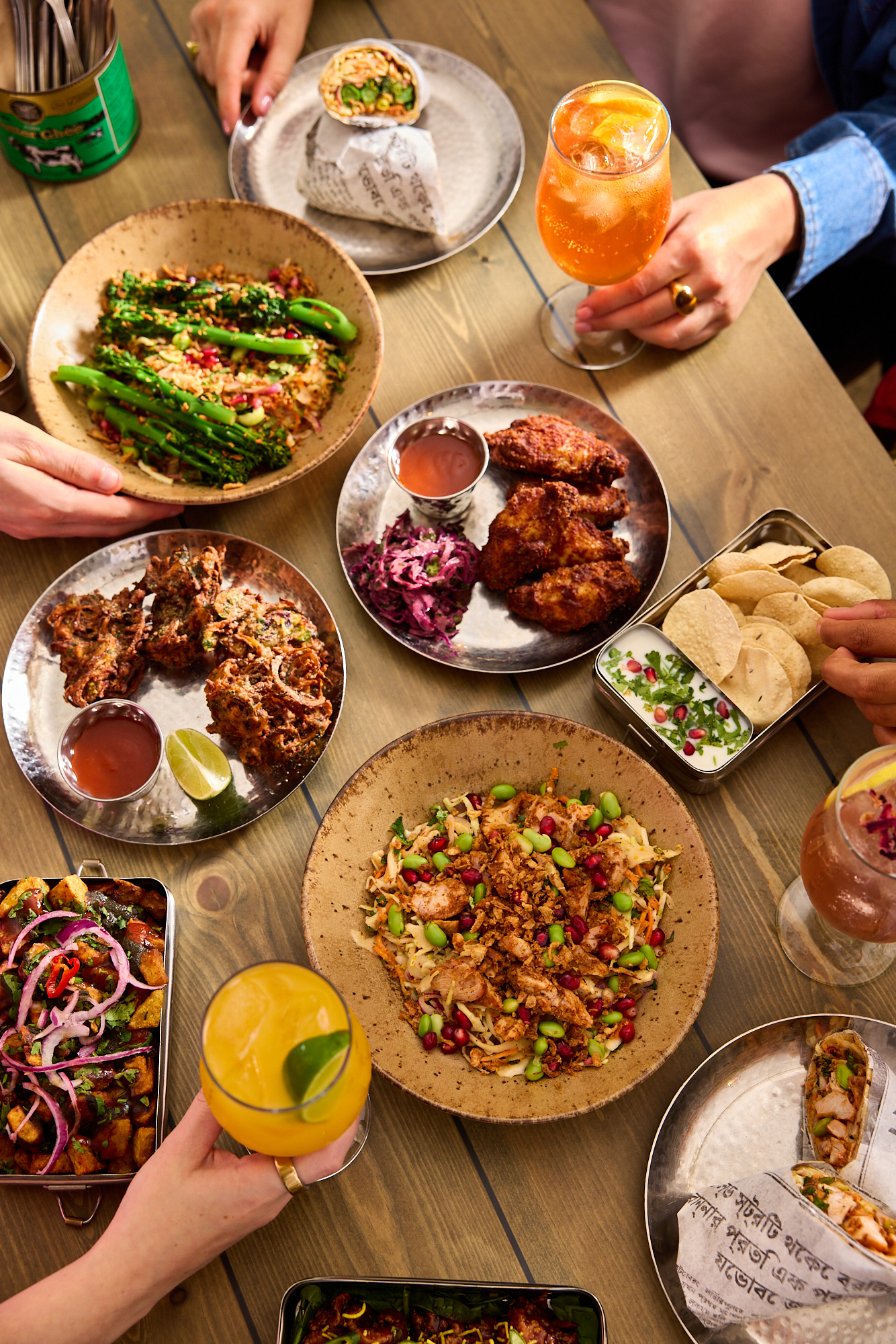
Good Indian street food is available across the UK in 2026, with strong options in cities including Manchester, Birmingham, Edinburgh, Glasgow, Leeds, Liverpool, Nottingham, Bristol, Newcastle, and London. The key is knowing what to look for: menus that include chaats, dahl, tandoori wraps, and sharing plates rather than just tikka masala and naan, and kitchens that cook fresh each day rather than relying on pre-made sauces.
Whether you are searching for vibrant restaurants near me or planning a trip to a new city, the quality of Indian street food across the UK has never been higher. The gap between London and the regional cities has narrowed considerably, and in some respects the regional cities now lead the way.
How Mowgli helps you find great Indian street food across the UK
Mowgli Street Food was built on exactly the kind of cooking this article is about: fresh, honest, home-style Indian food that reflects how people actually eat in India rather than a version of it filtered through decades of Anglo-Indian convention. Mowgli Street Food’s authentic Indian kitchen has grown from a single restaurant into a nationwide presence built on that same founding principle. Here is what that looks like in practice:
- Dishes cooked fresh each morning in every restaurant, including Temple Dahl, Mother Butter Chicken, and Mowgli House Lamb
- A menu built around sharing plates, street chaats, tiffins, and heirloom curries with full vegan and gluten-friendly options
- 27 locations across the UK, including Indian restaurant Manchester, Birmingham, Edinburgh, Glasgow, Leeds, Liverpool, Nottingham, Bristol, Newcastle, London, and more
- Walk-ins welcome, with table reservations available online
- Private and semi-private event hire options available at restaurant locations across the UK
If you are ready to find your nearest Mowgli, take a look at the full list of Mowgli restaurants and swing by.