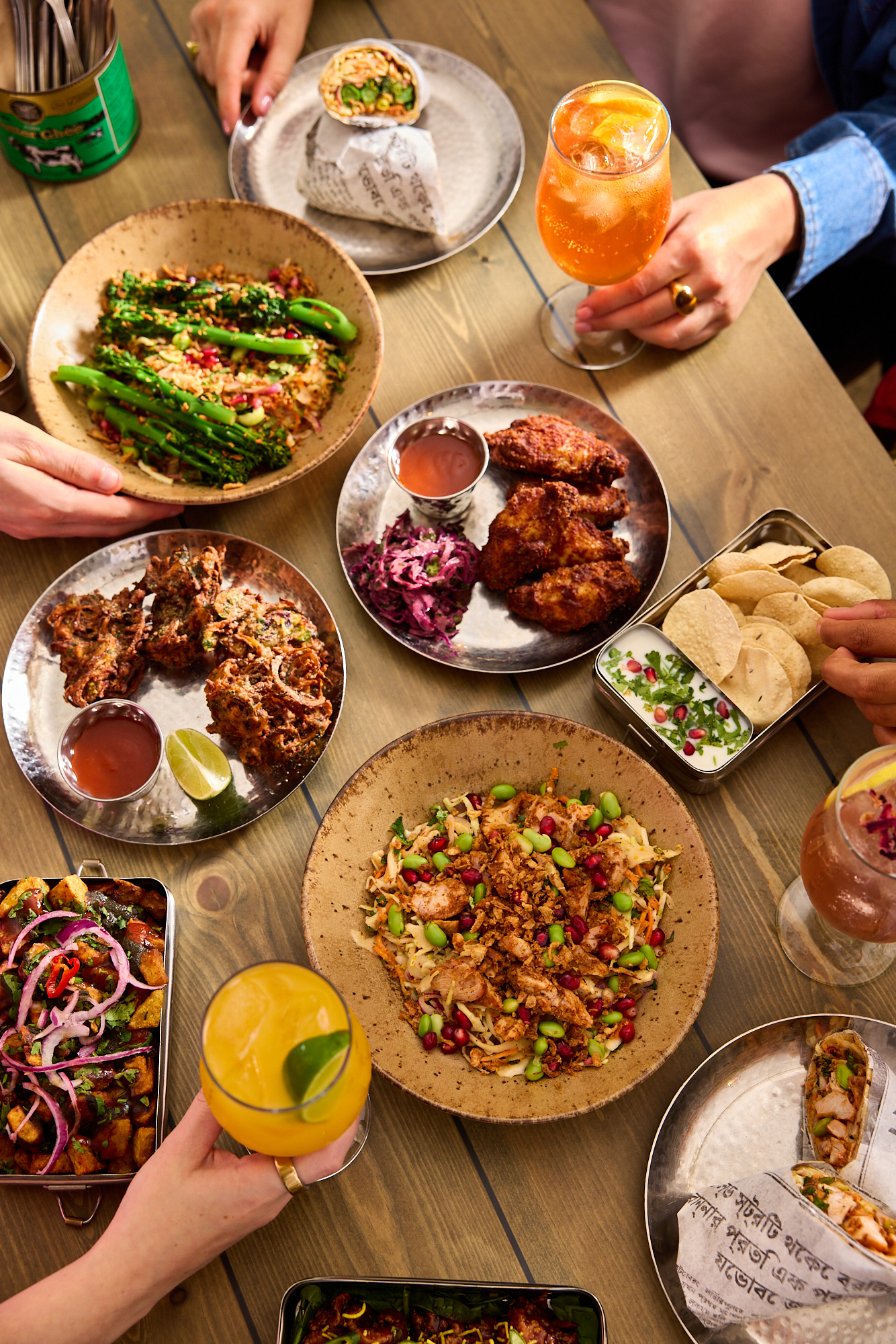
What makes an Indian restaurant have “good vibes” for a younger crowd?
Indian restaurants earn “good vibes” with younger crowds by combining a lively, social atmosphere with food that feels genuinely exciting rather than predictable. The ingredients are consistent: bold flavour, sharing-friendly menus, an honest sense of place, and a space designed for conversation rather than ceremony. Below, each of the questions younger diners most commonly ask about Indian dining gets a direct answer.
What creates a lively, social atmosphere in an Indian restaurant?
A lively atmosphere in an Indian restaurant comes from a combination of physical environment, food format, and energy. Communal tables, warm lighting, upbeat background sound, and a menu built around sharing plates all signal to guests that this is a place to relax, talk, and enjoy food together rather than sit in hushed formality.
The physical space does a lot of the heavy lifting. Swing seats, fairy lights, and open layouts invite guests to settle in rather than eat quickly and leave. But atmosphere is also about permission: when the menu is designed around small, shareable dishes rather than individual plated courses, the table becomes a shared experience. Food arrives at different moments, people reach across, conversation flows naturally between bites. That rhythm is fundamentally different from a traditional sit-down restaurant, and younger diners respond to it immediately.
Noise levels matter too, but not in the way older dining culture assumed. The best Indian restaurants near me searches consistently surface places where the energy feels alive rather than muted. That said, the buzz needs to be earned by the food and the crowd, not manufactured by a playlist alone.
Why do younger diners prefer sharing plates over traditional set menus?
Younger diners prefer sharing plates because they allow more variety, more spontaneity, and a more social experience at the table. Rather than committing to a single dish, sharing formats let a group of friends try five or six things, debate what to order next, and discover dishes they might never have chosen individually.
There is also a practical dimension. Group dining near me is a common search precisely because eating out is increasingly a social occasion rather than a functional one. When food is shared, the meal becomes a collective experience rather than a series of individual transactions. People remember the table more than they remember their own plate.
Indian street food is particularly well suited to this format. Dishes like chaat, dahl, tandoori wraps, and small curries are designed to be tasted alongside other things rather than eaten in isolation. The flavour profiles are bold enough to stand alone but varied enough to complement each other. A table of four ordering six or seven dishes between them will always have a more interesting meal than four individuals ordering one dish each.
What does ‘authentic’ Indian food actually mean to a younger crowd?
For younger diners, authentic Indian food means food that tastes like it was made for someone rather than for a market. It is home-cooked in spirit: recipes passed down through families, spices used with intention, ingredients that taste fresh rather than pre-prepared. It is the opposite of the standardised Anglo-Indian dishes that dominated British Indian restaurants for decades.
The word “authentic” has been used so often in restaurant marketing that it has lost some of its meaning. Younger diners have become good at reading past the label. What they actually respond to is specificity: a lamb dish described as an heirloom family recipe, a dahl made from red lentils simmered with toasted cumin, coriander, and lemon, a butter chicken that credits its sauce rather than hiding behind the category name. That kind of detail signals that someone actually cooked this, that there is a story behind it.
Authenticity also means honesty about what Indian food actually is. Real Indian home cooking is largely plant-based, light, and packed with fresh herbs and spices. It is not always heavy, creamy, or rich. When a restaurant reflects that truth on the menu, rather than defaulting to the stereotypes that have defined British Indian dining for generations, younger diners notice. It confirms that the restaurant understands the cuisine rather than simply performing it.
How does a healthy menu affect the vibe of an Indian restaurant?
A healthy menu makes an Indian restaurant feel more current, more honest, and more accessible to a wider range of diners. When guests can see that the food is genuinely nutritious rather than heavy and indulgent, it removes the sense of guilt that sometimes accompanies a night out and replaces it with something closer to genuine enjoyment.
This matters particularly for younger diners who are health-conscious without wanting to compromise on flavour or experience. The assumption that healthy food is bland and restaurant food is indulgent is one that a well-constructed Indian menu can dismantle entirely. Indian cuisine, at its core, relies on fresh vegetables, pulses, aromatic spices, and lean proteins. A menu that reflects that reality rather than hiding it is both more honest and more appealing.
Lighter options, clearly labelled vegan dishes, and calorie-conscious choices also affect the social dynamic of group dining. When everyone at the table can find something that genuinely suits them, the group can focus on the experience rather than negotiating around dietary needs. That ease contributes directly to the atmosphere. Fun restaurants near me searches increasingly surface places where the menu is inclusive enough that no one feels like an afterthought.
What role do a restaurant’s values play in its appeal to younger guests?
A restaurant’s values play a significant role in its appeal to younger guests because this generation actively chooses to spend money with brands they respect. A restaurant that gives back to its community, treats its staff well, and operates with transparency earns a kind of loyalty that good food alone cannot always generate.
This is not about virtue signalling. Younger diners are perceptive enough to distinguish between a brand that genuinely stands for something and one that has bolted a cause onto its marketing. What resonates is consistency: a restaurant whose values show up in how it hires, how it pays, how it engages with its local community, and how it talks about itself. When those things align with the food and the experience, the whole visit feels coherent.
Social responsibility has become part of the dining decision in a way that would have seemed unusual a decade ago. Choosing where to eat is, for many younger diners, also a statement about what they support. A restaurant that donates a portion of every meal to local causes, or that ranks consistently well as a workplace, communicates something real about its priorities. That matters to guests who see their spending as an extension of their values.
Which UK cities have the most vibrant Indian street food dining scenes?
Manchester, London, Birmingham, Edinburgh, and Bristol consistently stand out as the most vibrant cities for Indian street food dining in the UK. Each has a dense concentration of restaurants, a food-literate population, and a culture of eating out that makes Indian street food a natural fit rather than a niche offering.
Manchester’s Corn Exchange and the wider city centre have become a genuine destination for cool restaurants near me searches, with Indian street food well represented among the city’s most talked-about openings. London offers the sheer breadth of options, from Charlotte Street in the West End to Westfield Stratford in the east. Birmingham has a long-established South Asian food culture that has evolved to embrace modern street food formats alongside its traditional restaurants.
Edinburgh and Bristol have both developed strong independent dining scenes where Indian street food sits comfortably alongside other global cuisines. Cardiff, Leeds, Newcastle, Glasgow, Sheffield, Oxford, and Nottingham are all cities where the Indian street food scene has grown significantly in recent years, driven by younger populations who want drinks and food near me that feels genuinely exciting rather than safe and familiar.
The common thread across all of these cities is a dining public that is curious, well-travelled in its tastes, and willing to try something new. Indian street food, with its combination of bold flavour, sharing formats, and genuine culinary heritage, is well positioned to meet that appetite wherever it finds it.
How Mowgli Street Food delivers on every one of these things
Mowgli Street Food was built to answer exactly the questions younger diners are asking. Founded in Liverpool in 2014 by Nisha Katona, Mowgli brings Indian home cooking and street food culture to the British high street in a way that is honest, flavour-driven, and genuinely social. Here is how it delivers:
- Atmosphere: Swing seats, fairy lights, and open layouts designed for sharing and conversation, not ceremony
- Menu: Sharing plates built around Indian street food traditions, including Temple Dahl, Mowgli House Lamb, Mother Butter Chicken, and fresh chaat
- Health: Genuinely nutritious dishes, with full vegan and gluten-friendly options, reflecting the truth that real Indian food is light, fresh, and flavour-packed
- Authenticity: Recipes inspired by family heirlooms and home-cooking traditions, cooked fresh in each restaurant every morning
- Values: Through The Mowgli Trust, £1 from every meal goes to a local charity chosen by each restaurant’s team
- Events: Full venue hire, semi-private hire, and private dining rooms available across locations for group dining and special occasions
Mowgli has 27 locations across the UK, from Edinburgh and Glasgow to London, Bristol, Cardiff, and beyond. Whether you are looking for a casual catch-up, a group celebration, or simply somewhere that feels alive and worth the trip, find your nearest Mowgli and swing by.