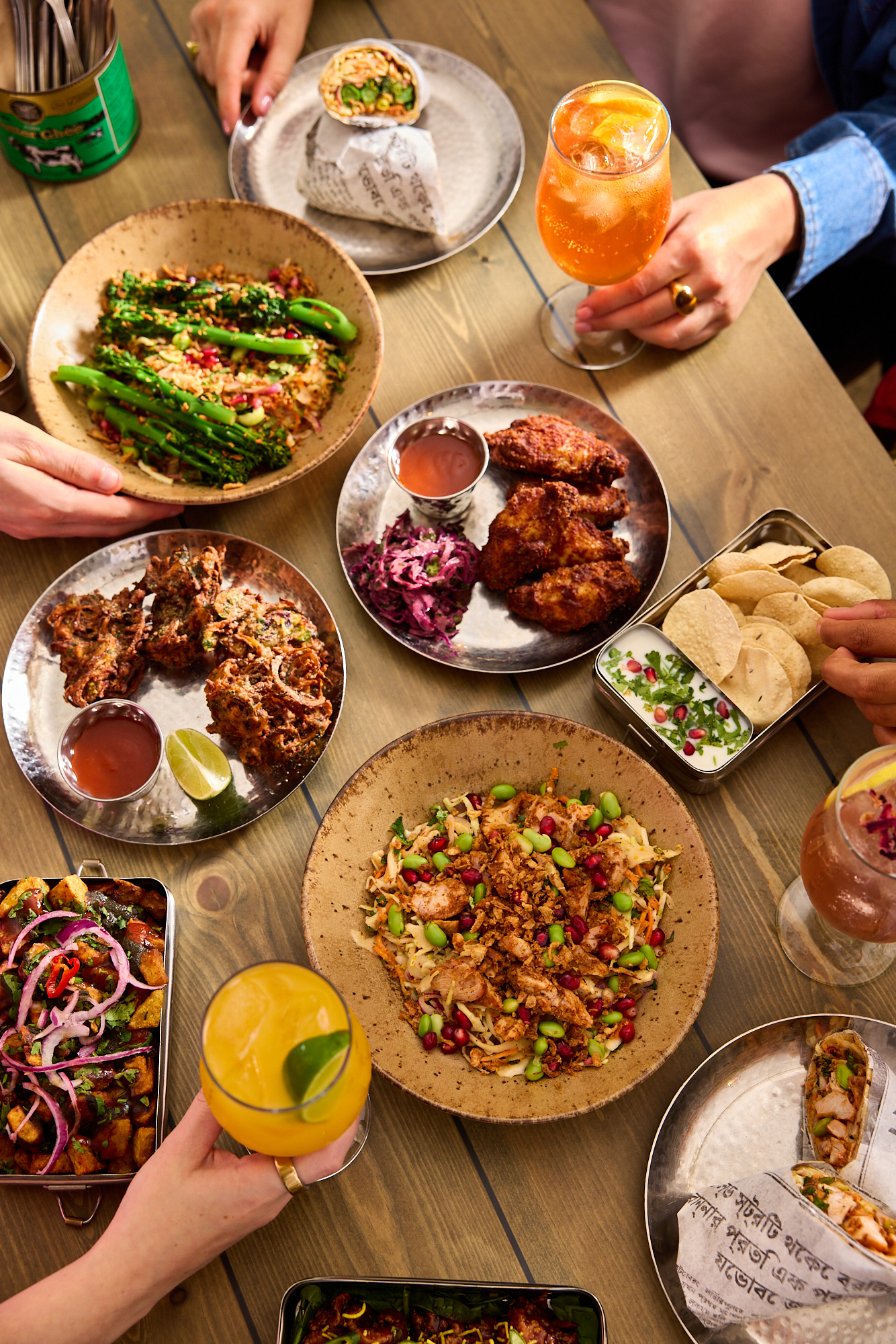
Why is sharing plates the best way to eat Indian food with friends?
Sharing plates is the best way to eat Indian food with friends because Indian cuisine is built for it. The food itself, from tangy street chaat to slow-simmered curries, is designed to be eaten in combination, with different flavours and textures playing off each other across the table. The sections below unpack why that is, and how to make the most of a shared Indian meal.
What makes Indian cuisine naturally suited to sharing?
Indian cuisine is naturally suited to sharing because it is structured around variety rather than individual portions. A traditional Indian meal is built from multiple dishes eaten simultaneously, not in sequence, so that every mouthful can draw from different bowls on the table. The food is designed to complement itself, with spice, acidity, richness, and freshness working together across the spread.
This goes back to how Indian home cooking actually works. A family meal in India rarely means one dish per person. It means a table covered in small plates, dals, breads, pickles, and curries, all eaten together in whatever combination feels right. Street food culture follows the same instinct: quick, bright, varied bites that layer flavour rather than deliver it all from a single source.
At Mowgli, that philosophy shapes the entire menu. Dishes like Temple Dahl, made from red lentils simmered with toasted cumin, coriander, and lemon, or Mowgli House Lamb, slow-cooked with onion, plum, and chickpeas until it falls apart, are not designed to be eaten alone. They are designed to be part of something bigger, shared across the table with people you actually want to sit with.
How does sharing plates change the flavour experience?
Sharing plates changes the flavour experience by giving you access to a much wider range of tastes, textures, and spice levels than a single dish ever could. When you eat from multiple bowls at once, you can move between rich and light, bold and subtle, hot and cooling, in a way that keeps every mouthful interesting. That contrast is what makes the meal feel alive.
Indian food is particularly well suited to this because its building blocks, spice blends, cooking methods, and base ingredients are so varied. A bite of something tangy and sharp from a street chaat followed by something slow-cooked and deeply spiced from a curry is a completely different experience to eating either dish alone. The combination does something neither dish can do on its own.
There is also something to be said for pace. Sharing plates naturally slows a meal down. You are reaching across the table, passing dishes, trying things you might not have ordered for yourself. That rhythm gives flavour time to register rather than being rushed through a single plate from start to finish.
Why do shared meals bring people together more than solo dishes?
Shared meals bring people together more than solo dishes because eating from the same plates creates a sense of participation that individual orders simply cannot replicate. When everyone at the table is involved in the same food, conversation follows naturally. You are commenting, recommending, passing things across, and reacting together, which is a genuinely social experience rather than a parallel one.
Research into communal eating consistently points to the same conclusion: people who share food report feeling more connected to the people they are eating with. There is something about the act of offering food from your own plate, or receiving it, that signals generosity and trust in a way that feels instinctive rather than learned.
Indian food culture has always understood this. The idea of feeding people well, of making sure everyone at the table has enough and has tried everything, is embedded in how Indian hospitality works. Mowgli was built on exactly that instinct: food that is meant to be shared with friends and family in the true Indian tradition, not portioned out and kept to yourself.
What types of Indian dishes work best for sharing?
The Indian dishes that work best for sharing are those with distinct flavour profiles that complement rather than compete with each other. A good shared spread typically combines something rich and slow-cooked, something light and fresh, something with heat, and something that provides a bit of texture or crunch. That balance is what makes the table feel complete.
Dishes that anchor the table
Slow-cooked curries and dals are the foundation of any shared Indian meal. They are rich, deeply spiced, and satisfying in a way that makes everything else on the table feel grounded. Mowgli House Lamb, for example, is the kind of dish that holds the centre of the table while other plates move around it. Mother Butter Chicken, tandoori chicken in a rich, spiced tomato and yoghurt sauce finished with butter, plays a similar role: familiar enough to be comforting, good enough to keep coming back to.
Dishes that add brightness and contrast
Street chaat and lighter dishes are what stop a shared spread from feeling heavy. They bring acidity, crunch, and freshness that cut through the richness of the slower-cooked plates. Temple Dahl, bright with lemon and toasted spices, does this well. These are the dishes that keep the table lively and stop any single flavour from dominating the whole meal.
How many dishes should a group order when sharing Indian food?
A good rule of thumb when sharing Indian food is to order roughly one dish per person, plus one or two extras for the table. So a group of four would typically order five or six dishes. This gives everyone enough variety to move between flavours without overloading the table or wasting food.
That said, the exact number depends on appetite, the size of the dishes, and how hungry the group is. If the table includes people with big appetites or you are planning a longer, more relaxed meal, leaning towards the higher end makes sense. If the group is lighter eaters or you are adding sides and breads, you might find fewer dishes go further than expected.
The more useful question is whether you have covered enough variety. A table of six ordering six of the same type of dish will have a less interesting meal than a table of four ordering five dishes that span different cooking methods, spice levels, and textures. Coverage matters more than volume.
Should you order the same dishes or mix it up when sharing?
You should always mix it up when sharing Indian food. Ordering a variety of dishes across different flavour profiles, spice levels, and cooking styles is what makes a shared Indian meal genuinely rewarding. Ordering multiples of the same dish removes the contrast that makes sharing worthwhile in the first place.
A well-mixed table gives every person at least one dish they would not have chosen for themselves, which is usually how people discover their new favourites. It also means the meal has movement and interest from start to finish rather than delivering the same flavour note on repeat.
If the group has dietary requirements or strong preferences, it is worth building the variety around those constraints rather than defaulting to safe repeats. Mowgli’s menu includes full vegan and gluten-friendly options across the spread, so it is genuinely possible to build a varied, balanced table without anyone feeling like they are eating a reduced version of the meal.
How Mowgli helps you get the most from a group dining experience
If you are planning a meal out with friends or family and want a setting that is built for sharing, Mowgli makes it straightforward. Here is what to know:
- The menu is designed around sharing, with dishes that complement each other across spice levels, textures, and cooking styles
- Full vegan and gluten-friendly options are available throughout, so mixed groups can order freely without compromise
- For larger groups, event and private hire options are available across locations, including full venue hire and semi-private spaces
- Dishes are cooked fresh each morning, so what arrives at the table is as good as it gets
- The atmosphere is lively and social, designed for the kind of meal where the conversation is as good as the food
Whether you are after a casual catch-up or something a bit more planned, find your nearest location and book a table at Mowgli to experience Indian street food the way it is meant to be eaten.
Related Articles
- Where Can You Find Indian Street Food Near Birmingham New Street Station?
- How do you plan the perfect evening of Indian food and cocktails?
- What makes Indian food perfect for a night out?
- What's the best Indian dish to order after a night out?
- How do you choose between casual dining and fine dining in the UK?