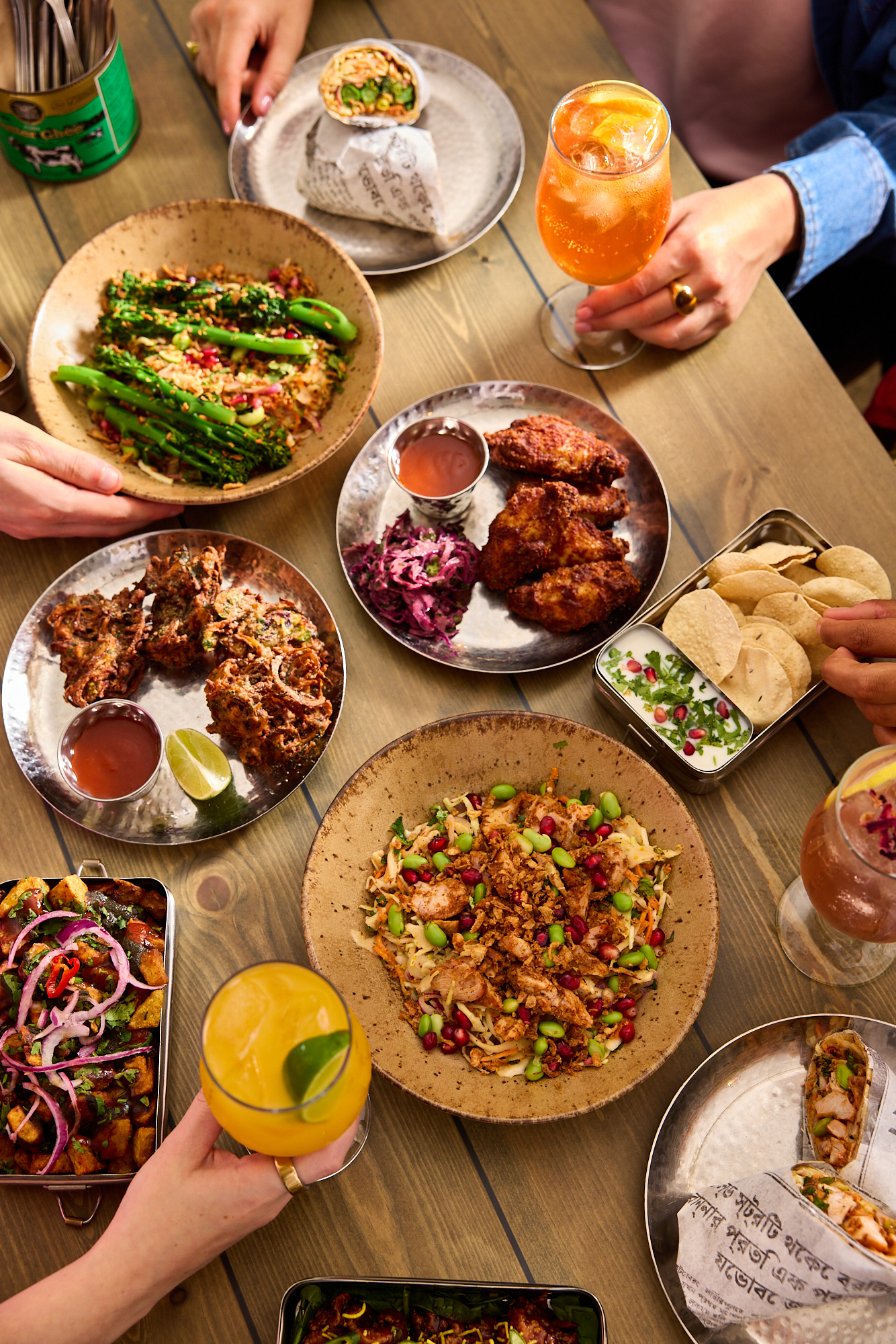
How do you turn dinner into a proper night out with Indian food?
The best way to turn dinner into a proper night out with Indian food is to lean into the sharing culture it was built on. Order a spread of dishes for the table, mix textures and heat levels, and let the food become the conversation rather than just the backdrop. Indian street food in particular lends itself to lively, social dining in a way that few other cuisines do. Below, we answer the questions that will help you plan a night worth remembering.
What makes Indian food ideal for a group night out?
Indian food is ideal for a group night out because it is built around sharing. The cuisine’s natural format involves multiple dishes arriving at the table simultaneously, each one designed to be passed around, dipped into, and eaten communally. That dynamic creates the kind of energy that makes a meal feel like an occasion rather than just eating out.
Unlike cuisines where everyone orders their own plate and largely eats in silence, Indian food encourages interaction. Someone reaches across for the dahl, someone else tears off a piece of flatbread to scoop up a curry, and suddenly the table is alive. The food does a lot of the social work for you.
There is also enormous variety within a single spread. You can have something bright and tangy sitting next to something slow-cooked and rich. That contrast keeps the meal interesting from the first bite to the last, and it means there is genuinely something for everyone at the table, whether they eat meat, avoid gluten, or prefer plant-based food.
How do you order Indian food for a table to share?
To order Indian food for a table to share, aim for roughly two to three dishes per person, mixing across categories: something light and fresh, something rich and sauced, something with a bit of heat, and a couple of sides to anchor it all. Avoid ordering everything from the same part of the menu.
A good spread has balance. If you have ordered a slow-cooked lamb dish that is deeply spiced and hearty, offset it with something bright, like a lentil dish finished with lemon and toasted cumin. If you are ordering for a group with mixed dietary preferences, Indian menus typically offer more genuinely satisfying vegan options than most other cuisines, so nobody ends up with the afterthought dish.
Ordering in rounds rather than all at once also works well. Start with street snacks or chaat to get the table going, then bring in the main dishes once everyone has settled. It mirrors the way Indian street food is actually eaten: in motion, in layers, without a rigid structure.
What’s the difference between street food and restaurant curry?
The key difference between Indian street food and restaurant curry is in the style, intention, and texture of the cooking. Street food is bold, quick, and built around contrast: sharp tamarind, cooling yoghurt, crisp textures, fresh herbs. Restaurant curry, in the traditional Anglo-Indian sense, tends to be richer, slower, and sauce-forward. Both are valid, but they offer a very different experience.
Street food dishes like chaat are designed to hit multiple flavour notes at once. They are tangy, spicy, sweet, and fresh in the same mouthful. They are also lighter, which means you can eat more of them without the heaviness that sometimes follows a traditional curry-house meal.
What many people do not realise is that the food most Indian families actually eat at home sits somewhere between the two. It is not the heavy, cream-laden dishes that became common in British Indian restaurants, and it is not always the extreme spice of roadside street food either. It is fresh, simple, and cooked with care. That is the tradition worth seeking out when you are looking for something that feels genuinely authentic rather than familiar.
Which Indian dishes work best for a lively, social table?
The Indian dishes that work best for a lively, social table are those designed to be shared and eaten without ceremony. Chaat, dahl, slow-cooked meat dishes, and tandoori-style wraps all travel well across a table and encourage the kind of relaxed, hands-on eating that makes a group meal feel social rather than formal.
For a table that wants variety, consider anchoring the spread with a slow-cooked dish that everyone can return to. Something like a lamb cooked down with onion and chickpeas until it falls apart gives the table a centrepiece without dominating. Pair it with a dahl, which is one of those dishes that works alongside almost anything, and add a couple of lighter plates to keep the energy moving.
Street food snacks are worth ordering early. They arrive quickly, they are easy to eat while everyone is still getting settled, and they set the tone for the meal. If the table is ordering drinks and catching up, having something to pick at immediately means nobody is waiting around.
For groups with mixed dietary needs, it is worth noting that many of the most flavour-packed Indian dishes happen to be vegan or easily made so. That makes it straightforward to build a spread where everyone is genuinely excited about what is in front of them, rather than one person quietly making do.
Where should you go for authentic Indian street food in the UK?
For authentic Indian street food in the UK, look for restaurants that cook fresh each morning, centre their menus around home-style recipes rather than Anglo-Indian curry-house staples, and offer a genuine mix of street snacks, dahl, and heirloom dishes alongside the more familiar options. The quality of the dahl alone is usually a reliable indicator of how seriously a kitchen takes its food.
If you are searching for Indian restaurants near me or group dining near me, the city you are in makes a difference. Most major UK cities now have at least one restaurant that has moved beyond the traditional curry-house format, offering something closer to the real breadth of Indian cooking. Birmingham, Manchester, Leeds, Edinburgh, Bristol, and London all have strong options.
When assessing whether a place is worth your evening, look at the menu structure. A restaurant that lists thirty-plus curries with nearly identical descriptions is likely working from a different tradition than one that names its dishes after family recipes or describes exactly how something has been cooked. Specificity in a menu is usually a sign that the kitchen means it.
How do you make Indian food the centrepiece of a full night out?
To make Indian food the centrepiece of a full night out, treat the meal as the event itself rather than a stop along the way. Choose a restaurant with an atmosphere that suits a group, order generously and in stages, and build the evening around the table rather than rushing through courses to get somewhere else.
The best group dinners with Indian food tend to have a loose structure. Drinks and street snacks first, then the main spread, then something sweet to finish. That rhythm gives the evening a shape without making it feel rigid. It also means the conversation has time to develop alongside the food, which is how a dinner becomes a night out rather than just a meal.
If you are planning something for a larger group, a birthday, a work dinner, or a celebration, it is worth looking into whether the restaurant offers event hosting. Some venues offer full or semi-private hire options that give you the atmosphere of a lively restaurant with a degree of privacy for your group.
How Mowgli helps you plan a group Indian food night out
Mowgli Street Food was built around exactly this kind of dining. Every location is set up for groups who want food that is fresh, bold, and genuinely shareable, in a setting that has energy without being chaotic. Here is what makes it worth considering for your next night out:
- Dishes are cooked fresh each morning, from Temple Dahl to slow-cooked heirloom recipes like Mowgli House Lamb
- The menu spans street chaat, tandoori wraps, and rich curries, with full vegan and gluten-friendly options throughout
- Three event hire options are available across locations: full venue hire, semi-private hire, and private dining rooms, each suited to different group sizes and occasions
- Restaurants are found across 27 UK locations, including Manchester, Leeds, Bristol, Edinburgh, Glasgow, London, Birmingham, Cardiff, Newcastle, and Sheffield
- Even locations not listed as event spaces may be bookable for special occasions upon request
If you are looking for fun restaurants near me or cool restaurants near me for a group that wants real flavour and a proper atmosphere, find your nearest Mowgli and see what is available. For groups with something to celebrate, the Mowgli events page is the place to start.